The Bitgrum Eyeing The World's Most Essential News Topics


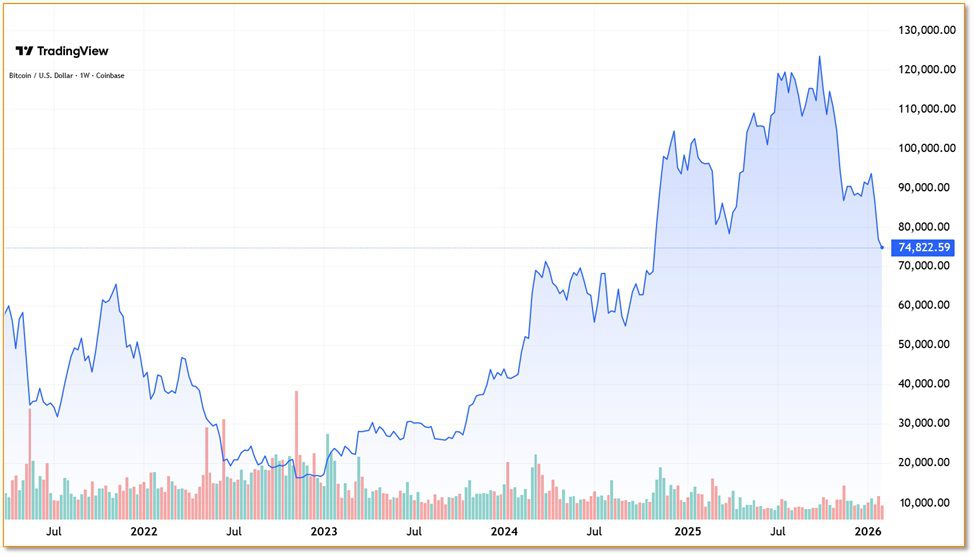
This week, Bitcoin fell below the crucial support of $73,000 on major exchanges, the lowest price since November 2024.
The drop has traders arguing whether this is a liquidity event or a more significant change in market structure.
Why $73,000 Matters
The $73,000 level has been a major support line during the current market cycle. It has been a high-volume point where buyers and sellers have been in constant conflict. The breach on Tuesday was not just a price drop; it is a test of Bitcoin’s foundation.
Although the same price action around this level was followed by a local bottom in April 2025, the recent breakdown does not have the immediate V-shaped recovery.
This has led analysts to consider the current situation as a potential inflection point and not a normal dip.
Market Context as Bitcoin Price is Off 40% from Peak
Bitcoin is now trading 40% from its all-time high of $126,210, which it hit in early October 2025. The fall is indicative of a wider rotation out of risk assets that has gained momentum in recent weeks.
Digital asset valuations are under pressure due to several macro factors:
- Policy disappointment: Delays in crypto-friendly legislative developments have dampened the regulatory enthusiasm that was already priced in the market. The lack of clarity regarding the attempts of lawmakers to establish legislative guardrails for the cryptocurrency industry has also added to investor caution.
- Risk-off mood: The increasing geopolitical anxieties have pushed capital into the conventional safe-haven assets. This reversal was accompanied by a wider sell-off in technology shares, as the NASDAQ dropped 2% on Tuesday as AI names, software stocks, and private equity saw sharp declines.
- Liquidation pressure: Over US$2 billion of Bitcoin positions have been liquidated since Thursday, which has a ripple effect that increased the downward price movement. On Saturday, liquidations across ALL cryptocurrencies amounted to US $2.56 billion (in a single day), the 10th-largest single-day liquidation in history.
Technical Levels to Watch
As Bitcoin digests this breakdown, analysts are tracking three key indicators:
- Support-to-resistance flip: The most important test will be whether Bitcoin will be able to regain US$73,000. When this level serves as resistance to rally efforts, it is a sure sign of structural failure and not a shake-out.
- The US$70,000 demand zone: In case of weakness, the next significant zone of historical demand is the high-60,000 to low-70,000 zone, where buyers can be found.
- Volume dynamics: A sustainable bottom usually involves a capitulation event, a surge in selling volume, and then stabilization, to signal that the distribution phase is complete.
What Analysts Are Saying
Rob Hadick, general partner at Dragonfly Capital, noted that the pullback does not seem to be motivated by any one factor. He said that the crypto and bitcoin prices have never been stable and that this market is not an exception, but the fundamentals of the crypto market are still good, especially with the growing popularity of stablecoins and tokenized assets.
Nonetheless, in a recent memo, Bitwise CIO Matt Hougan proposed that the market is in a true crypto winter since early 2025, and not in a temporary correction.
Looking Ahead
Although the drop below US$73,000 is a major technical blow, the experienced market participants consider such corrections as necessary for healthy price discovery in volatile assets. Bitcoin has already shown its resilience, and it has bounced back several times after sharp drops in its history.
The next weekly close will be important in deciding whether this is a strategic entry point to long-term holders or the start of a longer period of consolidation. The most significant pivot point in the near-term price action seems to be at the US$73,000 level.
Investors are advised to remember that cryptocurrency markets are very volatile and the previous performance does not guarantee future results.
CHART 1: Bitcoin 5-Year Chart